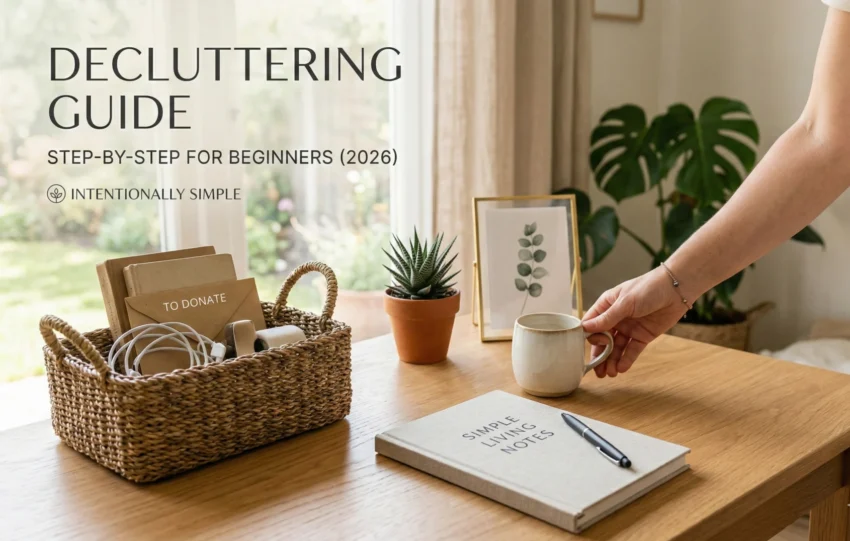
To follow an effective decluttering guide, start by choosing one small area, like a single drawer, to build momentum. Use a step-by-step decluttering process: categorize items into “keep,” “donate,” and “discard.” Focus on one room at a time to avoid feeling overwhelmed, and establish a simple decluttering system to maintain your space daily.
- What is decluttering, and why does it actually matter?
- Is there a biological cost to keeping all this stuff?
- Is there a simpler way to follow a decluttering guide?
- How do I start decluttering today?
- Why your "Organization" is making things worse
- Which are the most effective decluttering methods?
- Your Room-by-Room Decluttering Guide
- The 30-Day Decluttering Challenge
- Decluttering Checklist (The "Intentionally Simple" Edition)
- What are the common decluttering mistakes to avoid?
- How to maintain a clutter-free home for good?
- Frequently Asked Questions
- The One-Minute Challenge
According to a landmark study by UCLA’s Center on Everyday Lives of Families (CELF), there is a direct correlation between high cortisol (stress) levels in homeowners and a high density of household objects.
You are standing in the middle of your living room, and for the first time in a long time, you actually see it. Not the curated version you show guests, but the reality. The stack of mail that has become a permanent architectural feature on the sideboard. The “spare” charging cables for phones you haven’t owned since 2019. The heavy, invisible hum of too much stuff.
If you’re wondering how to start decluttering when overwhelmed, you aren’t alone. Most people approach their homes like a battlefield, armed with trash bags and a sudden, frantic energy that burns out by lunch. But this isn’t about a weekend war. This is about a slow living decluttering guide that respects your energy and your history.
Maybe you’ve searched for a decluttering guide for beginners because the walls feel like they’re closing in. Or perhaps you need to know how to declutter your home step by step without losing your mind in the process. Whatever brought you here, welcome. We’re going to move slowly, breathe deeply, and peel back the layers of “just in case” until we find your home again.
What is decluttering, and why does it actually matter?
At its heart, decluttering isn’t about getting rid of things; it’s about making room for what remains. It is the intentional act of removing the physical and mental barriers between you and the life you want to lead.
When we talk about minimalist decluttering, we aren’t talking about living in a white box with one spoon. We’re talking about financial freedom with slow living—realizing that when you own less, your money and your time belong to you again.
Clutter is just a series of delayed decisions. That pile of clothes on the chair? That’s a decision you haven’t made yet. The broken toaster in the pantry? Another delay. By following a simple decluttering system, you are finally giving yourself permission to decide.
Is there a biological cost to keeping all this stuff?
Your brain is a processing machine, but it has a finite bandwidth. Every object in your field of vision is a silent demand for your attention. In the world of slow living health, we look at how environment impacts the nervous system.
Chronic clutter keeps the body in a state of low-grade “fight or flight.” Your brain’s neuroplasticity—its ability to rewire its own habits—is actually hindered by visual noise.
Researchers at the Princeton University Neuroscience Institute found that physical clutter in your environment competes for your attention, resulting in decreased performance and increased stress. When you declutter your home, you aren’t just cleaning; you are literally lowering your cortisol levels and giving your prefrontal cortex a chance to rest.
Check the Decluttering category for more posts
Is there a simpler way to follow a decluttering guide?
Most people think decluttering is a marathon. It’s actually more like gardening. You don’t just “finish” a garden; you tend to it. Here is how the Intentionally Simple approach differs from the traditional “hustle” methods.
| Feature | High Stress | Slow |
| Timeframe | Entire house in a weekend | One drawer or shelf at a time |
| Mindset | “I must get rid of everything.” | “What do I want to keep?” |
| Energy | Manic, frantic, leads to regret | Calm, decisive, leads to peace |
| Sustainability | Re-clutters within a month | Builds a permanent lifestyle shift |
| Goal | Aesthetics for social media | Ease of movement and mental clarity |
How do I start decluttering today?
If you feel paralyzed, don’t look at the whole room. Look at your feet. Here is a three-step ritual to break the seal on your step-by-step decluttering journey:
-
The Five-Minute Sweep: Set a timer. Pick up five items that clearly don’t belong in the room you’re in. Put them where they go or put them in the bin.
-
The Surface Reset: Clear one flat surface—just one. Maybe it’s the coffee table or the kitchen island. Keep it clear for 24 hours.
-
The “One In, Two Out” Rule: For the next week, if you bring something new into your house, find two things to let go of. This shifts your brain from “acquiring” to “curating.”
Why your “Organization” is making things worse
Here is the rebellious truth: you cannot organize clutter. Buying more clear plastic bins is often just a high-end way of procrastinating. We’ve been sold the idea that home organization tips involve buying more stuff to hold our stuff.
Real minimalist decluttering means you don’t need the bins because you have fewer things to manage. If you have to move three boxes to get to the one thing you need, the system is broken. Stop organizing. Start eliminating.
Which are the most effective decluttering methods?
There is no one-size-fits-all, but these five frameworks are the gold standard for decluttering for beginners.
1. The Four-Box Method
Label four boxes: Keep, Donate, Sell, Trash. As you go through a space, every single item must go into one of these boxes. No “maybe” piles allowed. “Maybe” is where clutter goes to live forever.
2. The 90/90 Rule
Look at an object. Have you used it in the last 90 days? Will you use it in the next 90? If the answer is no to both, it’s likely a “straggler.” This is particularly effective for how to declutter fast when you’re dealing with a garage or hobby room.
3. The Packing Party
Popularized by the minimalists, you pack everything in a room into boxes as if you’re moving. Over the next month, you only take out what you actually need. At the end of the month, you’ll be shocked by how much is still in the boxes.
4. The “Clutter Burst”
Set a timer for 15 minutes every morning. This is about how to start decluttering without it feeling like a second job. When the timer pings, you stop. It keeps the “linguistic friction” of the task low.
5. The Gentle Ripple
Start at the front door. Move clockwise around the house. Only move to the next “station” once the current one is finished. This creates a visible “clean zone” that expands over time.
6. The 10-10-100 Rule
Think of this as the “gentle math” of letting go. You commit to removing 10 unnecessary items from your home every day for 10 days. By focusing on these bite-sized habits rather than a total overhaul, you successfully remove 100 items in under two weeks without feeling brain-fried or emotionally drained. Learn more about the 10-10 decluttering method here.
Your Room-by-Room Decluttering Guide
To make this a realistic decluttering plan, we need to break the house down into functional zones. Don’t try to do these all in one day. Give each room a week if you have to.
How to declutter the Bedroom?
The bedroom should be a cathedral of rest. It is the most important room for slow living health. According to the National Sleep Foundation, a clean and organized bedroom environment is significantly linked to better sleep quality.
-
Clear the Nightstands: Only items for sleep (a book, a lamp, water).
-
Under the Bed: If you haven’t looked under there in a year, it’s a graveyard. Clear it out to let air circulate.
-
The “Chair”: You know the one. The chair covered in “half-worn” clothes. Commit to either hanging them up or putting them in the laundry.
How to declutter the Kitchen?
The kitchen is the engine of the home. Home organization tips here focus on “prime real estate.”
-
The Gadget Audit: If you have a cherry pitter you use once a year, move it to deep storage or donate it.
-
Duplicate Check: Do you really need four spatulas? Choose your favorite two and let the rest go.
-
The Pantry Purge: Check expiration dates. Be ruthless. If you haven’t cooked those lentils in two years, you aren’t going to start today.
How to declutter the Closet?
This is usually the most emotional area. We keep clothes for the “future version” of ourselves or the “past version” we miss.
-
The Hanger Trick: Turn all your clothes hangers backward. When you wear an item, turn the hanger the right way. After six months, see which hangers are still backward.
-
The “Would I Buy It Today?” Test: If you were in a shop right now, would you spend money on that sweater? If not, why is it taking up space in your home?
-
The Sentiment Trap: Keep one or two items that truly hold memories, but don’t let your closet become a museum of who you used to be.
How to declutter the Living Room?
This is a communal space. It should facilitate conversation, not storage.
-
Media Check: In 2026, most of our media is digital. Do you really need the DVD collection or the tower of old magazines?
-
Surface Tension: Clear the coffee table and the mantle. Only put back items that bring you genuine joy or serve a purpose.
-
The Toy Rotation: If you have kids, implement a rotation system. Only a few toys out at a time; the rest stay in a “toy library” in the closet.
How to declutter the Bathroom?
The bathroom is the easiest place to start because it’s mostly logical, not emotional.
-
The Expiration Search: Sunscreen, makeup, and medicine all expire. Toss anything past its prime.
-
The Sample Hoard: Those tiny hotel shampoos? You aren’t going to use them. Donate them to a local shelter.
-
The Towel Limit: You likely only need two towels per person. Why do you have fifteen?
The 30-Day Decluttering Challenge
If you like a structured 30-day decluttering challenge, follow this calendar. It’s designed to start easy and build your “letting go” muscles.
-
Day 1-5: The Easy Wins. (Mismatched socks, junk mail, expired food, old pens, dead batteries).
-
Day 6-10: The Living Zones. (Magazines, remote controls, throw pillows, coasters, candles).
-
Day 11-15: The Kitchen. (Tupperware without lids, duplicate utensils, old spices, chipped mugs).
-
Day 16-20: The Bathroom & Linens. (Old makeup, raggedy towels, half-empty bottles, old meds).
-
Day 21-25: The Wardrobe. (Shoes that hurt, clothes that don’t fit, stained items, old jewelry).
-
Day 26-30: The Digital & Paper Trail. (Email subscriptions, old receipts, desktop icons, phone apps).
Decluttering Checklist (The “Intentionally Simple” Edition)
Print this out or save it to your phone. Check one box a day.
-
[ ] The Junk Drawer: Empty it completely. Only put back what you use weekly.
-
[ ] The Medicine Cabinet: Safely dispose of expired prescriptions.
-
[ ] The Fridge Door: Remove the magnets and menus you no longer need.
-
[ ] The Bookshelf: Donate the books you know you’ll never read again.
-
[ ] The “Project” Pile: Admit you aren’t going to fix that broken lamp. Let it go.
-
[ ] The Car: Clean out the glove box and the trunk.
-
[ ] The Entryway: Create a “landing strip” for keys and bags.
What are the common decluttering mistakes to avoid?
Even with a step-by-step decluttering plan, people stumble. Here’s what to look out for:
-
Buying bins before purging: You end up organizing trash.
-
Starting with sentimental items: This is the “boss level.” Start with the bathroom.
-
The “Garage Sale” Trap: Thinking you’ll sell everything. If it doesn’t sell in two weeks, it stays in your house. Just donate it and move on.
-
Doing it for someone else: You can only declutter your things. The American Psychological Association (APA) notes that forced cleaning often leads to family conflict; focus on your own space first to lead by example.
How to maintain a clutter-free home for good?
Maintenance is the “slow living” part of this decluttering guide. It’s not a one-time event; it’s a rhythm.
-
The Daily Reset: Spend 10 minutes every evening putting things back in their “homes.”
-
The “One-Touch” Rule: If you pick something up, put it away. Don’t put it down.
-
Mindful Consumption: Before you buy something new, ask: “Where will this live?” and “What will this replace?”
-
Seasonal Audits: Every time the seasons change, do a quick sweep of your wardrobe and pantry.
Frequently Asked Questions
How do I declutter when I’m overwhelmed by the mess?
Start with the “Trash-Only” pass. Walk through your house with a bin bag and only look for literal trash—wrappers, broken items, old mail. This lowers the stakes and creates immediate visual progress without requiring hard emotional decisions.
What is the fastest way to declutter a whole house?
The “Packing Party” is the fastest. By boxing everything up and only “un-boxing” what you use, you bypass the decision-making fatigue that usually slows people down. What’s left in the boxes after 30 days is your decluttering list.
How do I decide what to keep and what to throw away?
Use the “Value vs. Volume” test. Does this item provide enough value (utility or genuine joy) to justify the volume of space it occupies? If you have a giant bread maker you use once a year, the volume outweighs the value.
Is minimalist decluttering expensive?
Actually, it’s the path to financial freedom. By choosing minimalist decluttering, you stop the cycle of “buy-clutter-organize-repeat.” You spend less, maintain less, and realize you already have enough.
How do I handle sentimental clutter?
Take a photo of the item. Often, we want the memory, not the object. A digital photo takes up no space but preserves the “spark” of the memory. For the truly precious, create a small, curated “memory box” with a strict size limit.
How can I make decluttering a sustainable habit?
Think of it as slow living decluttering. Instead of a yearly “spring clean,” make it a part of your weekly chores. When you treat your home as a living, breathing space rather than a storage unit, the habit becomes natural.
The One-Minute Challenge
Your home is the backdrop of your life. It shouldn’t be a source of guilt or a list of chores. By following this decluttering guide, you aren’t just cleaning a room; you are reclaiming your peace of mind.
The goal isn’t perfection. The goal is frictionlessness. It’s about being able to find your keys, make a cup of tea, and sit down on your sofa without having to move a pile of laundry first. That is the true luxury of slow living.
Before you close this tab, go to one drawer in your house—just one—and find three things to throw away or put in a donation bag. Do it right now. Feel that small ripple of space you just created.
