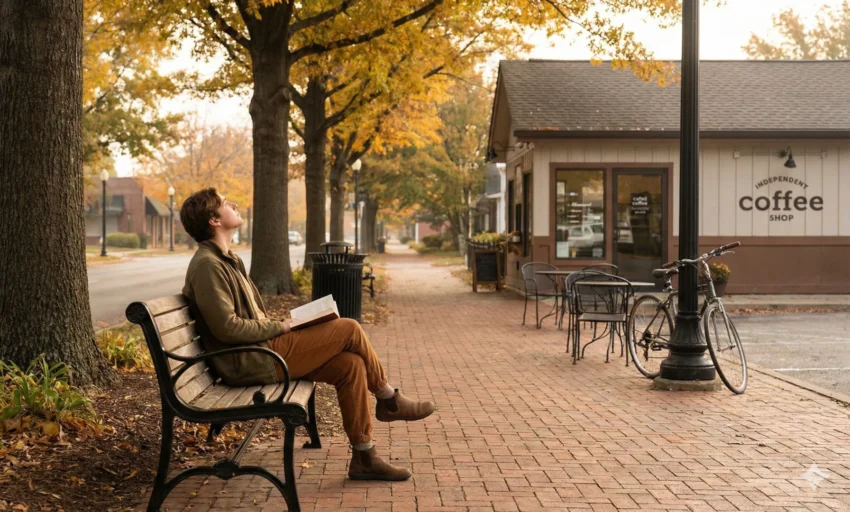
Hyperlocal urban slow living in Overland Park is the intentional design of a life where your essential needs—nature, nourishment, and community—are met within an 18-minute radius. It replaces the exhausting “commuter culture” with a high-trust, low-friction environment that prioritizes time-wealth over material speed, allowing residents to reclaim hours for mindful presence.
Overland Park was recently ranked by Digital Journal as America’s best city for slow living, boasting an average 18-minute commute and 70% park accessibility for its residents.
There is a specific kind of heaviness that settles into your shoulders when you’re staring at a red light on Metcalf Avenue, watching the clock tick past the time you promised to be home. It’s a quiet, persistent thrum of anxiety—a feeling that life is happening somewhere else, and you are simply the person stuck in the transition.
We’ve been told for decades that the suburban dream required a sacrifice: your time in exchange for a zip code. But in the heart of Kansas, something is shifting. People are beginning to ask for their hours back.
In Overland Park, we are witnessing the rise of hyperlocal urban slow living, a quiet rebellion against the “drive-everywhere” mentality. It’s not about moving to a cabin in the woods; it’s about finding the woods at the end of your block. When we talk about how to start slow living in a city, we aren’t talking about checking out; we’re talking about checking in.
Whether you are exploring slow living communities in Kansas or simply trying to figure out minimalist urban lifestyle tips that actually work in the Midwest, the secret lies in the 18-minute radius. This is the “sweet spot” where your brain stops scanning for the next exit and starts noticing the way the light hits the tallgrass at the Arboretum.
Finding benefits of slow living in the suburbs used to feel like an uphill battle, but with new infrastructure projects focusing on walkability and “human-scale” design, the best cities for slow living in USA lists are finally including places that look like home. We’re moving away from the frantic pace and toward a life where “local” isn’t a marketing buzzword, but a lived reality.
Check our Slow Living Around the World Category for more posts.
Why is our current pace of life causing a biological cost?
Your body wasn’t built for 70 miles per hour. It was built for about three. When we spend our lives vibrating at the frequency of high-speed traffic and digital notifications, we pay a price in what scientists call “allostatic load.” This is essentially the wear and tear on your body that accumulates when you’re constantly exposed to chronic stress.
Think of your nervous system like a rubber band. In a natural state, it stretches when you face a challenge and snaps back to a relaxed state when the threat is gone. In a high-friction urban environment, that band stays stretched 24/7.
This leads to a breakdown in neuroplasticity—which is just a fancy way of saying your brain’s ability to rewire its own habits. When you’re constantly rushed, your brain gets stuck in “survival mode,” making it nearly impossible to make the calm, intentional choices required for a simple life.
A staggering 20% of Americans report feeling constantly rushed in their daily lives, according to recent social surveys. This “time poverty” is more than just an inconvenience; it’s a health crisis. It spikes cortisol, disrupts sleep, and thins out the very social connections that keep us grounded. In Overland Park, reclaiming those 18 minutes isn’t just about convenience; it’s about giving your nervous system permission to stand down.
Is there a simpler way to embrace hyperlocal urban slow living?
The transition from a high-speed suburban existence to a slow, intentional one doesn’t happen overnight. It requires a shift in how we view our geography. We’ve been conditioned to think bigger is better—more square footage, more car range, more options. But true freedom is actually found in the “less.”
| High Friction | Slow Living |
| Driving 20 minutes to a big-box gym. | A 10-minute walk to a local park or trail. |
| Ordering everything online for “convenience.” | Walking to the Downtown OP Farmers’ Market for seasonal food. |
| Seeing neighbors only through a windshield. | Knowing the names of the people on your “18-minute loop.” |
| Spending weekends “maintaining” a massive lawn. | Native landscaping that invites birds and requires less toil. |
| Multitasking through a drive-thru lunch. | Sitting at a local café without a phone for 20 minutes. |
| Measuring success by the speed of the “hustle.” | Measuring success by the depth of your afternoon rest. |
By narrowing your focus to what is reachable within a short walk or bike ride, you eliminate the “transition friction” that eats up your day. You stop being a spectator of your city and start being a participant in its rhythm.
How do I start practicing a slow living ritual today?
You don’t need a lifestyle overhaul to begin. You just need a few “anchors” in your day that refuse to be rushed. Here is a simple, low-friction ritual designed for the Overland Park resident:
-
The 10-Minute Porch Sit: Before you touch your phone in the morning, step outside. Whether you’re in a quiet cul-de-sac in the Wycliff neighborhood or a modern apartment near OP Central, just sit. Listen to the morning. This resets your circadian rhythm and tells your brain that you are the one in charge of the tempo.
-
The Neighborhood Loop: Find a specific path in your neighborhood—ideally one that passes through a green space like Bluejacket or Switzer Park. Commit to walking this same path three times a week. The repetition allows you to notice the subtle changes in the seasons, which is the ultimate cure for “digital amnesia.”
-
The Single-Task Errand: Once a week, choose one errand that you can do on foot or by bike. Maybe it’s getting a coffee at a local roaster or picking up one ingredient for dinner. The goal isn’t efficiency; the goal is presence.
-
The Digital Sundown: At 8:00 PM, put the devices in a drawer. The blue light from screens is a “speed signal” to your brain. Replacing it with warm light and a physical book allows your neuroplasticity to work in your favor, prepping your mind for deep, restorative rest.
Why “Inconvenience” is the Secret to Happiness
We have been sold a lie that “convenience” is the same thing as “quality of life.” We buy the faster car, the quicker meal, and the instant delivery because we think it saves us time. But what do we do with the time we save? Usually, we just fill it with more work or more scrolling.
The rebellious truth is that friction is actually good for you. When you choose to walk to the library instead of downloading an e-book, you encounter the sun on your face, the smell of the air, and the chance encounter with a neighbor. These “inconveniences” are the threads that weave a community together.
Overland Park’s shift toward better sidewalks and “neighborhood street reconstruction” isn’t just a public works project; it’s a social architecture project. It’s creating a city where it’s actually easier to be human. True luxury in 2026 isn’t the ability to go anywhere fast—it’s the ability to stay somewhere beautiful and feel completely at peace.
Frequently Asked Questions
What are the best slow living communities in Kansas?
While many small towns offer a slower pace, Overland Park is leading the way in “urban slow living.” Neighborhoods like the historic Downtown area and the developing “OP Central” corridor are designed to balance modern amenities with walkable, green-heavy environments that support a decelerated lifestyle.
How can I find minimalist urban lifestyle tips for families?
Start by “decluttering” your schedule before your home. Choose one local park—like the Overland Park Arboretum—and make it your family’s “third place.” Focus on experiences that don’t require a long drive, allowing your children to develop a deep connection to their immediate environment.
What are the main benefits of slow living in the suburbs?
The primary benefit is the reclamation of “lost time.” By reducing commute lengths and prioritizing local resources, residents lower their chronic stress levels, improve physical health through increased walking, and foster stronger social ties with neighbors, leading to higher overall life satisfaction.
Are there specific best cities for slow living in USA?
Overland Park consistently ranks at the top of these lists due to its unique combination of low noise pollution, high access to public parks (over 80 in the city), and a commitment to infrastructure that supports “18-minute” connectivity for its residents.
The One-Minute Challenge
Tomorrow morning, leave your phone in the house and walk to the end of your driveway or the edge of your balcony. Stand there for exactly sixty seconds and find three things you can hear that aren’t man-made. The wind in the oaks, a bird, the crunch of dry leaves. That’s it. You’ve just started your 18-minute secret.
