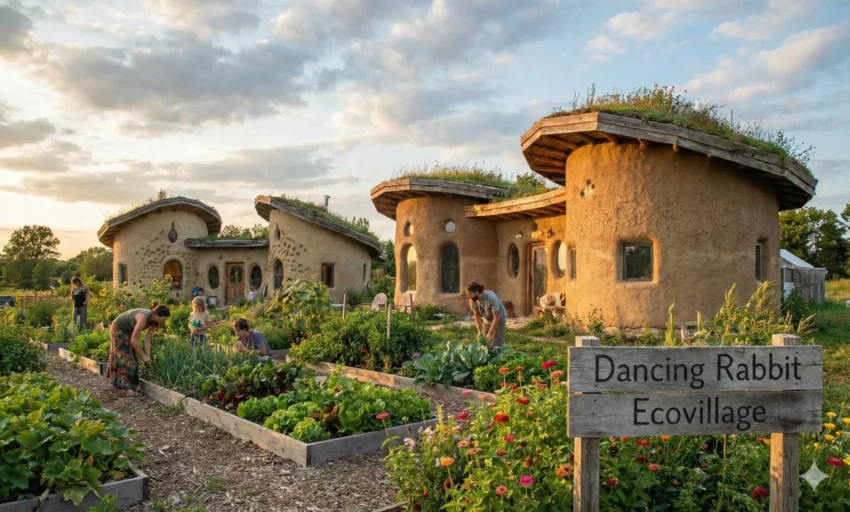
The Dancing Rabbit Ecovillage lifestyle is a radical model of a slow community that uses an internal currency, called “Rabbits,” to foster local resilience. Located in Missouri, the village limits the use of federal dollars to decouple from global market stress, reduce its carbon footprint, and encourage residents to trade skills and goods directly with one another.
Research from the Global Ecovillage Network confirms that Dancing Rabbit residents use roughly 10% of the resources and energy consumed by the average American household, largely due to their localized economic systems.
The first thing you notice when you step onto the 280 acres of the northeast Missouri prairie isn’t the silence—it’s the absence of that low-frequency hum of digital transactions that usually defines our days. Here, the air smells of cured wood and wild sunflowers, and the pace of life feels less like a race and more like a steady, purposeful stroll.
People often ask what is it like living at Dancing Rabbit Ecovillage, expecting to hear about a life of total sacrifice. They imagine people sitting in the dark, cold and disconnected. But the reality of the Dancing Rabbit Ecovillage lifestyle is far more vibrant and, quite frankly, more sophisticated than the world we left behind.
This slow community hasn’t just opted out of the rat race; they’ve built a new track entirely. One of the most rebellious things they’ve done is put a “buffer” between themselves and the US dollar. By leaning into the benefits of internal community currencies, the village has created a protective bubble against the inflation, anxiety, and anonymity of the global market.
If you have spent your nights researching how to join an intentional community in Missouri, you are likely seeking more than just a garden and a compost toilet. You are looking for a way to stop the bleeding of your time.
You want to know if sustainable living practices in ecovillages are actually viable for a modern person who still wants a sense of security. At Dancing Rabbit, that security comes from your neighbors, not your bank account.
The Dancing Rabbit Ecovillage cost of living is shockingly low, not because people have nothing, but because they share everything—from a community car-share program to a tool library that makes individual ownership look like a burden.
For those who take the leap through the Dancing Rabbit Ecovillage visiting program, the revelation is always the same: we have been paying for things with our lives that we could have been getting for free through friendship.
Check our Slow Living Around the World Category for more posts.
What is the biological cost of our current financial system?
Our current economic system treats the human nervous system like a battery—something to be drained and then replaced. When we live in a world where every need is met through an anonymous, digital transaction, we lose the social feedback loops that kept our ancestors safe. This creates a state of “perceived isolation,” which triggers the brain’s amygdala.
When you worry about the “market” or your “credit score,” your brain isn’t processing a tool; it’s processing a threat. This leads to a constant drip of cortisol—the stress hormone—into your bloodstream. Over years, this “financial fight-or-flight” response causes real damage to your neuroplasticity, or your brain’s ability to rewire its own habits. You become stuck in a loop of high-stress survival, making it nearly impossible to experience the “slow living” you crave.
In a traditional city, if you don’t have dollars, you don’t eat. That is a biological emergency. In a village with an internal currency, if you don’t have “Rabbits,” you still have neighbors who know you, you have a garden you’ve helped tend, and you have a social safety net that is physically present.
By switching to a local currency, the residents at Dancing Rabbit are essentially performing a massive experiment in “neuro-restoration.” They are lowering the baseline stress of their community by ensuring that economic activity reinforces social bonds rather than breaking them. You will find a resident trading local currency for a jar of honey-a transaction rooted in trust, not in a faceless algorithm.
Is there a simpler way to embrace the Dancing Rabbit Ecovillage lifestyle?
You don’t necessarily need to pack your bags for the Missouri prairie to start living like a “Rabbit.” The core of their success is a shift in how they define “wealth.” In the default world, wealth is a stack of paper or a digital digit. In an intentionally simple life, wealth is the number of people you can call when your car breaks down or your garden is overflowing with tomatoes.
| Feature | The Transactional Life | The Relational Life |
| Money | Dollars (Anonymous and scarce) | “Rabbits” or Barter (Personal and abundant) |
| Energy | Grid-tied (Coal/Nuclear/Gas) | Sun and Wind (Locally harvested) |
| Housing | Speculative asset (Mortgage-heavy) | Shelter (Straw-bale, cob, and communal) |
| Food | Industrial (Pesticides and plastic) | Permaculture (Soil-building and seasonal) |
| Waste | “Away” (Landfills and sewers) | Resource (Human-scale composting) |
| Community | Transactional (Paying for services) | Mutual Aid (Exchanging skills and time) |
Embracing this doesn’t mean you stop using dollars tomorrow. It means you begin to look for the “leaks” in your life where you are paying for things that could be solved through community. It’s about shrinking your economic footprint until it fits within the boundaries of your own neighborhood.
How do I start building a slow community today?
The transition to a simpler, more connected life doesn’t happen with one big move; it happens through small, consistent rituals that slowly shift your dependence from “the system” to “the people.”
-
The Local Exchange Audit: For one week, try to satisfy at least three of your needs without using a major corporation. Trade a skill with a friend, buy from a local farmer’s market, or borrow a tool. Feel the difference in the interaction.
-
The “Time-Bank” Ritual: Set up a simple “favor ledger” with two or three close neighbors. If you watch their kids for an hour, they owe you an hour of gardening or home repair. This is an internal currency in its purest form.
-
The Media Detox: Turn off financial news. The global market’s fluctuations are designed to keep you in a state of high-arousal fear. If you aren’t an active day trader, you don’t need to know the S&P 500’s hourly performance. Focus on your “internal market”—your home and your health.
-
The “Common Sense” Purchase: Before buying something new, ask yourself: “How many hours of my life did this cost?” If a $200 gadget cost you 10 hours of work, ask if that gadget will give you 10 hours of genuine joy. Most often, the answer is no.
-
The Saturday Social: Host a “low-tech” gathering. No phones, no expensive catering. Just a potluck and conversation. This is the foundation of a slow community—relearning how to be together without a commercial middleman.
Money is a Wall, Not a Bridge
We are sold the idea that money is a tool for connection. We believe that if we have enough of it, we can travel the world and “connect” with everything. But the rebellious truth practiced at Dancing Rabbit is that the more money you have, the less you actually need people.
If you have enough money, you can buy privacy. You can buy a fence. You can buy a private chef, a private gym, and a private theater. You can effectively “pay away” every opportunity for a meaningful, slightly messy human interaction. This is why the wealthiest neighborhoods are often the loneliest.
The internal currency at Dancing Rabbit is a “friction” by design. It forces you to interact. It forces you to be a person of character because your “credit” in a small village is your reputation. When you “ban the dollar” (or even just limit its power), you tear down the wall that keeps you isolated. You begin to realize that the things we think we are “buying” with our hard-earned dollars—safety, belonging, and peace—are actually the natural byproducts of a community that relies on itself.
Frequently Asked Questions
What is it like living at Dancing Rabbit Ecovillage?
It’s a life characterized by high-touch social interaction and low-impact environmental choices. You live in a house you likely helped build, eat food grown by people you know, and spend your days engaged in work that has immediate, visible value to your neighbors.
What are the benefits of internal community currencies?
Internal currencies keep wealth “sticky.” Instead of your money leaving the community to go to a corporate headquarters, it stays in the village, moving from the baker to the builder to the gardener, strengthening the local economy with every exchange.
What is the Dancing Rabbit Ecovillage cost of living?
The financial cost is very low—often a fraction of the national average—because of shared resources and minimal infrastructure needs. However, the “social cost” is higher, as it requires more active participation, communication, and cooperation than a standard suburban life.
How do I join an intentional community in Missouri?
Start by researching the various communities like Dancing Rabbit, Red Earth Farms, or Sandhill. Most require a visitor period. It’s not about an application; it’s about finding a “cultural fit” where your skills and values align with the group’s mission.
What are common sustainable living practices in ecovillages?
Expect to see solar and wind power, “humanure” (composting toilets), natural building techniques like cob or straw-bale, rainwater catchment systems, and cooperative land management that prioritizes biodiversity over manicured lawns.
How does the Dancing Rabbit Ecovillage visiting program work?
The program is an immersive experience where you live in the village, work alongside residents, and attend “culture” classes. It’s designed to strip away the romanticized version of community and show you the practical, daily reality of slow living.
The One-Minute Challenge
Take a walk through your neighborhood today with no phone and no wallet. Just walk. Try to make eye contact and say hello to three people. This is the first step in reclaiming your local “market”—reminding yourself that the people around you are your greatest resource, not the numbers in your banking app.
