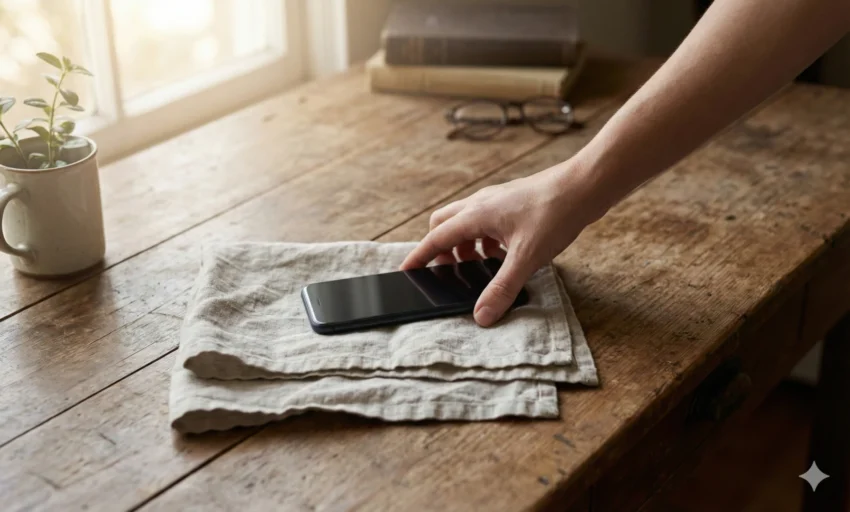
The screen flickers into blackness. You place the cold glass slab on the heavy oak table. For a second, the silence of the room is absolute, yet your pulse is racing. You feel a sharp, unexplained spike of anxiety after putting phone away, a phantom weight pulling at your midsection as if you’ve just stepped off a moving train into a void.
Your thumbs still twitch with the muscle memory of the scroll. The air in your apartment feels thin. You are experiencing the “Digital Withdrawal,” a silent epidemic stalking the residents of our modern world.
The Silence is a Ghost: Why the End of the Scroll Feels Like a Loss
This unease isn’t a character flaw. It is a biological protest. When we are tethered to our devices, we are not just “looking at content.” We are plugged into a high-frequency stream of dopamine and external validation that keeps our nervous system in a state of perpetual readiness.
The moment that stream is cut, the brain experiences a sudden drop in stimulation. It is the psychological equivalent of a car going 100 miles per hour and slamming into a brick wall. The silence that follows isn’t peaceful; it feels like a threat.
The Biological Cost: The Amygdala’s False Alarm
At the center of this distress is your amygdala. This ancient part of your brain is your primary alarm system. Its only job is to scan the horizon for predators or opportunities.
Digital notifications have hijacked this system. The red notification bubbles and the haptic vibrations are interpreted by the amygdala as “high-priority” signals. They keep you in a state of sympathetic nervous system dominance—the “fight or flight” mode.
When you put the phone down, your amygdala doesn’t simply turn off. It remains hyper-vigilant, wondering where the next signal went. Your body is flooded with a lingering wash of cortisol. This chemical residue is what creates that vibrating sensation of dread in your stomach.
Your brain believes that by putting the phone away, you have been separated from the “tribe” or have missed an urgent warning. It is an evolutionary response to a non-evolutionary stimulus.
The Cultural Trap: The High-Velocity Pulse of the Global Hub
This phenomenon is most aggressive in our global high-velocity hubs. If you are walking through the financial districts of London, the neon-drenched streets of Singapore, or the concrete canyons of New York, the pressure to be “on” is atmospheric.
In these transit centers, your worth is often measured by your responsiveness. The culture demands that you be a node in a 24/7 network. To disconnect is to become invisible.
We have built cities that never sleep and networks that never close. This creates a collective “mental load” that we carry in our pockets. The anxiety you feel is the friction between your human need for rhythmic rest and the metropolitan demand for constant output.
You aren’t just putting down a phone; you are opting out of a global race. That transition requires a “soft landing” that our modern infrastructure fails to provide.
Is it normal to feel unease when the screen goes dark?
Yes, it is a documented response to the “Reward-Predictive Stimuli” found in modern interfaces. To bridge the gap between the digital hum and human silence, you must implement a somatic bridge.
Here is the 3-Step Ritual to Exit the Digital Loop:
-
The Physical Anchor: The moment you put your phone down, touch something natural and textured. Grip the edge of a wooden table, feel the grain of a linen cushion, or hold a ceramic mug. This sensory input overrides the “phantom vibrations” and tells your brain you are safely in the physical world.
-
The Exhale Extension: Your breath is the remote control for your nervous system. Inhale for four seconds, but exhale for eight. The long exhale triggers the vagus nerve and sends a manual signal to your brain to switch from the sympathetic (stress) to the parasympathetic (rest) state.
-
The Five-Minute “Nothingness” Buffer: Do not immediately jump into a productive task after putting your phone away. Sit for five minutes and allow the dopamine levels to stabilize. Let the boredom arrive. It is the only way to lower your baseline of stimulation.
The Counter-Intuitive Truth: Boredom is a Nutrient
We have been conditioned to see boredom as a vacuum that must be filled. We treat an empty minute like an empty stomach—as something that needs to be satisfied with a “snack” of content.
But boredom is actually a vital nutrient for the prefrontal cortex. It is in the “in-between” moments that our brain performs essential maintenance. This is when we process emotions, consolidate memories, and generate original thoughts.
The anxiety you feel after putting your phone away is actually the sensation of your brain “re-booting” its internal processing. If you immediately reach back for the phone to kill the discomfort, you are interrupting a vital biological repair.
The goal isn’t to never feel that spike of unease. The goal is to become comfortable with it. To realize that the “quiet” isn’t a void—it is a sanctuary.
Reclaiming the Sovereignty of Your Attention
Living intentionally in 2026 requires a rebellious spirit. It requires you to be okay with being “unproductive” for a few minutes while your neurochemistry recalibrates.
When you put your phone down and feel that wave of anxiety, look at it with curiosity. Recognize it as the “digital ghost” leaving your system.
The more often you sit through that 120 seconds of discomfort without reaching back for the screen, the stronger your “focus muscles” become. You are training your brain that it does not need a glass rectangle to feel safe.
You are reclaiming your humanity, one quiet minute at a time.
The One-Minute Challenge: Put your device down right now. Place it in a different room. Sit in a chair with your hands on your lap for exactly sixty seconds. Do not look at a clock. Just feel the weight of your body in the seat. Notice the silence. Let the anxiety rise, and then let it pass.
