What is the Morocco slow living market culture? Morocco slow living within market culture is defined by shwiya b shwiya (little by little), a philosophy that prioritizes social connection over the speed of a transaction. It transforms shopping into a communal ritual involving tea, conversation, and mutual respect, which reduces stress and fosters deep communal bonds between artisans and neighbors.
Research from the Global Wellness Institute suggests that communal “third spaces”—like the Moroccan souk—are vital for longevity and psychological resilience, as they provide consistent, low-stress social interactions that lower chronic cortisol levels.
The first thing you notice in the Marrakesh medina isn’t the color of the spices or the intricate geometry of the tiles. It’s the friction. In our modern, digitized world, we have been conditioned to see friction as a failure.
We want the one-click checkout, the automated door, and the silent, anonymous delivery. But in the heart of Morocco, friction is where the humanity lives. To understand morocco slow living, you have to stop seeing the crowded market as an obstacle and start seeing it as a sanctuary of presence.
As you navigate the narrow, sun-drenched alleys, the air is thick with the scent of cedar shavings and fresh mint. You aren’t just walking through a place of commerce; you are walking through a living manifesto for a different kind of life.
The local rhythm is governed by the phrase shwiya b shwiya—little by little. It is a radical refusal to be hurried by the demands of a clock. When you participate in this slow market philosophy, you realize that the “chaos” of the souk is actually a highly evolved system designed to keep people connected to one another.
We often think of “slow living” as something that happens in a quiet cottage in the woods. But the Moroccan version is much more resilient. It’s a slow life lived in the middle of the noise. It teaches us that peace isn’t the absence of activity; it’s the presence of intention. By shifting from a “consumer” mindset to a “neighbor” mindset, we can reclaim our time and our joy, whether we are in the middle of Marrakesh or a suburban supermarket.
What is Morocco’s slow market culture and when did it start?
To understand morocco slow living, we have to look past the vibrant rugs and the towers of spices. At its core, this culture is an ancient “operating system” for human connection. It isn’t just a way to buy things; it’s a way to belong. The slow market culture is a social contract where time is the primary currency, and the quality of your relationship with the merchant is more important than the speed of the sale.
This way of life didn’t happen by accident. It began over a thousand years ago with the founding of the great medinas like Fes el Bali in the 9th century. These walled cities were designed as car-free, high-density labyrinths where everything—from the width of the streets to the placement of the communal fountains—was built at the “human scale.”
Without the rush of wheels or the pressure of mass industry, the people developed a pace that respected the limits of the human body and the needs of the human spirit.
For centuries, the Moroccan artisan culture has been the backbone of this system. In the traditional guild system, an apprentice would spend years just learning how to sit, how to watch, and how to hold their tools before they were ever allowed to sell a single item.
This deep-time perspective is the root of shwiya b shwiya. It is a recognition that anything worth doing is worth doing slowly. By looking at these 1,200-year-old roots, we realize that our modern obsession with “optimization” is actually the outlier. The slow market isn’t a relic of the past; it’s a blueprint for a more intentional future.
Check our Slow Living Around the World for more posts
Is there a simpler way to understand the impact of slow market culture?
In Morocco, the market is the neighborhood’s pulse. It isn’t just where you get your bread; it’s where you are seen, heard, and acknowledged. This constant, gentle social weaving has a profound effect on the collective psyche. When every errand is an opportunity for a five-minute conversation, the isolation that plagues modern life simply cannot take root.
The people of the medina don’t just “buy” things; they build relationships with the things they use. When you know the man who hammered your copper pot or the woman who wove your wool blanket, the object carries a weight of responsibility and care.
This is mindful consumption at its most visceral. It prevents the “disposable” culture that fuels our anxiety. In Morocco, a rug isn’t just floor covering; it’s a story shared over three glasses of tea. This social glue creates a sense of safety and belonging that is often missing in our high-speed, “optimized” cities.
| The High-Speed Life (The Efficiency Trap) | The Morocco Slow Living Way (The Connection Path) |
| Shopping as a chore to be completed as fast as possible | Shopping as a social ritual that anchors the day |
| Valuing an item based on its price and convenience | Valuing an item based on the artisan’s skill and the story |
| Anonymous transactions that leave us feeling isolated | Face-to-face exchanges that build community trust |
| Living for the “weekend” or the “exit.” | Living for the rhythm of the present moment |
| Constant digital distraction while moving through the world | Sensory immersion in the sounds, smells, and textures of life |
How do Moroccans live a slow life through their markets?
The secret lies in the “unproductive” moments. A Moroccan merchant might spend half his day sitting on a stool, watching the world go by, and talking to his neighbors. To a Western eye, this looks like “wasted time.” But in the context of intentional living habits, this is the most productive thing he can do. He is regulating his nervous system, strengthening his social network, and remaining grounded in the “now.”
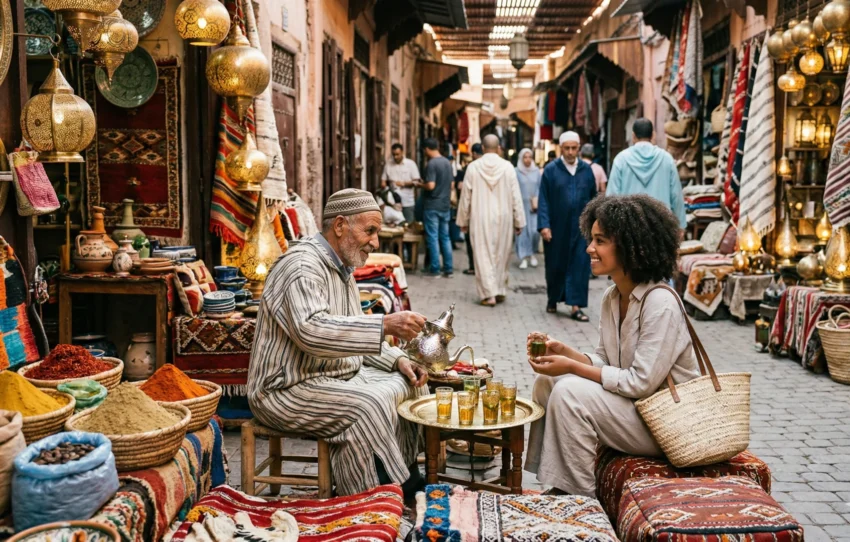
The Moroccan tea ceremony is the perfect example of this. You cannot rush it. The water must boil, the mint must steep, and the tea must be poured from a height to create the perfect foam. If you try to speed it up, you offend the guest and ruin the tea.
By submitting to the ritual, you are forced to drop your agenda. You are reminded that the world will not stop spinning if you sit still for twenty minutes. This “forced pause” is a cultural gift that keeps the people of Morocco resilient in the face of life’s pressures.
How can I practice this culture no matter where I live?
You don’t need to move to North Africa to adopt the morocco slow living mindset. The “slow market” is a state of mind that you can carry into any environment. It’s about choosing depth over speed in your daily interactions.
-
The “Human First” Greeting: The next time you are at a checkout counter, don’t just wait for the total. Look the person in the eye and offer a genuine greeting. Ask a question that isn’t transactional. In Morocco, this is the Salam Alaykum—the recognition of the soul before the wallet.
-
The Sensory Walk: When you run errands, leave your phone in the car. Notice the texture of the pavement, the smell of the bakery, or the sound of the wind. By engaging your senses, you turn a chore into a form of slow travel through your own neighborhood.
-
The “Shwiya” Pace: Commit to doing one task today at half-speed. Whether it’s folding laundry or typing an email, do it with deliberate grace. If you feel the urge to “hurry up,” ask yourself what you are actually rushing toward. Usually, it’s just the next task.
-
Find Your “Artisan”: Seek out local makers in your community. Go to the farmers’ market, the local woodworker, or the independent bookstore. By choosing to buy from a person rather than a corporation, you are participating in the Moroccan artisan culture of mutual support.
-
Build a “Tea Boundary”: Create a daily ritual that cannot be moved or rushed. It doesn’t have to be mint tea. It could be a ten-minute walk or a cup of coffee. The rule is that during this time, you are “unavailable” to the digital world. You are only available to the present.
The Counter-Intuitive Truth
We are often told that to find peace, we need to “get away from it all.” We buy noise-canceling headphones and book isolated retreats. But the morocco slow living philosophy suggests that true peace is found by “getting into it all.”
It is the radical act of staying present when things are loud. It is the rebellion of refusing to be efficient when a human connection is on the table. The merchants of Marrakesh aren’t living slow because they have “nothing to do”; they are living slow because they have chosen to prioritize the things that actually matter: the tea, the talk, and the trade. When we stop trying to “save” time and start actually spending it on the people in front of us, we find the financial and emotional freedom we’ve been searching for.
Frequently Asked Questions
How to practice slow living in Morocco?
Spend your mornings in the same cafe every day. Watch the market wake up. By becoming a “regular,” you shift from being a spectator to a participant in the local rhythm of shwiya b shwiya.
What is the meaning of shwiya b shwiya in daily life?
It means “little by little.” It is the antidote to “all at once.” It encourages you to take life in small, manageable pieces, focusing on the quality of the current step rather than the distance of the destination.
How can I apply Moroccan slow living to my office job?
Start your meetings with five minutes of non-work conversation. Build “friction” into your day—walk to a colleague’s desk instead of sending a Slack. These micro-connections act as a social buffer against stress.
Why is the Moroccan market culture good for mental health?
It reduces isolation. In a traditional souk, it is nearly impossible to feel “invisible.” The constant acknowledgement from neighbors and merchants provides a sense of communal security that lowers anxiety.
What are the best ways to experience slow travel Morocco?
Avoid the “day-trip” mentality. Stay in a riad for at least four days. Give yourself permission to have “zero-goal” afternoons where your only job is to follow a specific scent or sound through the medina.
Can any person practice slow market culture?
Yes. It is a change of intent. By choosing to value the human exchange over the speed of the result, you can turn a trip to a suburban post office into a mindful, “slow” experience.
The One-Minute Challenge
Tomorrow, during your most “rushed” moment, stop. Take sixty seconds to look at your surroundings as if you were a traveler in a foreign land. Find one thing that is beautiful or interesting that you would usually ignore. For that one minute, adopt the pace of shwiya b shwiya.
