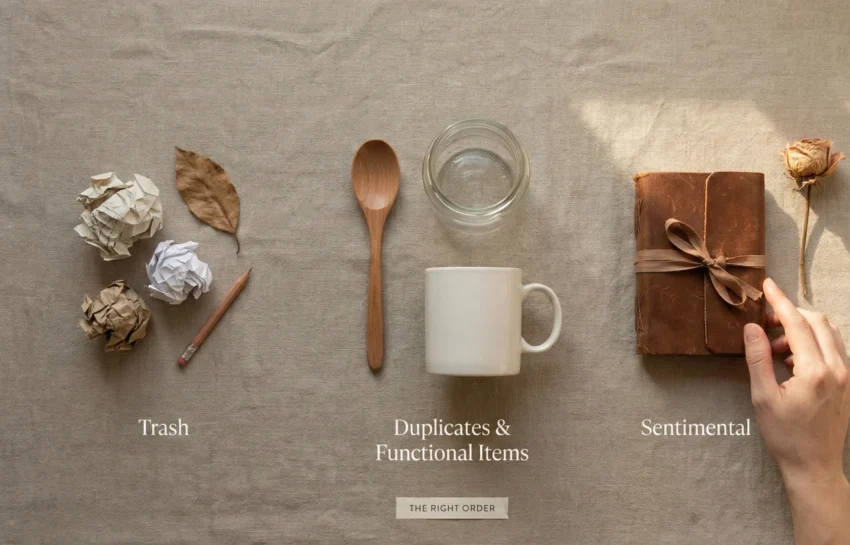
To learn how to declutter effectively, you must stop focusing on the volume of “stuff” and start with your easiest wins first. The right order begins with clear trash, moves to non-sentimental duplicates in the bathroom or pantry, and saves emotional items for last. This builds the decision-making muscle needed for a permanent lifestyle shift.
A study published in The Journal of Environmental Psychology found that clutter can significantly decrease a person’s sense of well-being and productivity by overstimulating the visual cortex.
I remember standing in the middle of my living room three years ago, surrounded by half-empty cardboard boxes and a mounting sense of defeat. I had spent eight hours “cleaning,” yet the house looked worse than when I started. I was following the classic advice: start with the big stuff. I was trying to tackle the garage and the attic—the graveyards of my past—and I was drowning in the emotional weight of it all.
If you feel like you’re constantly shifting piles of mail from the counter to the table, you aren’t lazy. You are likely just learning how to declutter in the wrong order. Most of us treat a messy house like a puzzle we can solve with enough caffeine and willpower.
We look for the best way to declutter a messy house and find lists that tell us to “just do it.” But willpower is a finite resource, and when you start with the hardest items first, you run out of gas before you even hit the kitchen sink.
Finding where to start decluttering when overwhelmed is less about the broom and more about your brain. If you want a decluttering checklist for beginners that actually works, you have to stop fighting your biology.
You need a system that builds momentum, turning the act of letting go into a habit rather than a trauma. These minimalist decluttering tips aren’t about having a “perfect” home; they are about finding how to declutter for mental health benefits so you can finally breathe in your own space. You deserve a home that feels like a deep exhale, not a mounting to-do list.
Check the decluttering category for more posts.
What is the biological cost of living in clutter?
Your brain is a high-performance engine, but it has a limited bandwidth. Every object in your field of vision is a silent demand for your attention. That stack of unread magazines? That’s a “should.” The broken toaster on the counter? That’s a “to-do.” When your home is filled with these micro-stressors, your nervous system stays in a state of low-grade “fight or flight.”
This isn’t just a feeling; it’s about your neuroplasticity—your brain’s ability to rewire its own habits. When you live in a cluttered environment, your brain constantly processes “visual noise.” This spikes your cortisol, the hormone responsible for stress. Chronic clutter makes it harder for your brain to focus and filter information. It’s like trying to have a private conversation in a room where ten people are shouting different instructions at you.
When you finally learn the right order to clear the space, you aren’t just cleaning a room. You are lowering the “noise floor” of your life. You are giving your brain the breathing room it needs to rest and recover. The biological cost of keeping things “just in case” is paid for with your peace of mind.
Is there a simpler way to how to declutter?
The traditional approach to organizing is often flawed because it focuses on organizing rather than removing. We buy pretty bins and labels, thinking that will solve the problem. But you cannot organize your way out of having too much stuff.
| Feature | Backward | The Right Order |
| Starting Point | The “Big Project” (Garage/Attic) | The “Easy Win” (Trash/Bathroom) |
| Mindset | “I might need this one day.” | “Does this serve the person I am today?” |
| Strategy | Organizing into bins and labels. | Removing the excess until no bins are needed. |
| Pace | Weekend-long marathons (Burnout). | 15-minute daily rituals (Consistency). |
| Emotional Load | Starts with sentimental items. | Saves sentimental items for the very end. |
The “Intentionally Simple” way acknowledges that decision-making is a muscle. If you haven’t exercised that muscle in years, you shouldn’t start by lifting the heaviest emotional weights in your life. You start with the light stuff. You start with the trash.
How do I start Decluttering tips today?
If you are ready to reclaim your space, forget the grand overhaul. We are going to use a simple, low-friction ritual to get the energy moving. This is how to declutter a house room by room without losing your mind in the process.
-
The “Surface Sweep” (5 Minutes): Grab a trash bag. Walk through every room and pick up only what is objectively garbage. Old receipts, candy wrappers, broken pens, and expired coupons. Do not look at anything else. This builds immediate “completion energy.”
-
The Bathroom Reset: This is the best room for beginners. There is very little emotion in a half-empty bottle of shampoo or an expired tube of toothpaste. Clear the surfaces. If you haven’t used that specific lotion in six months, let it go.
-
The Duplicate Hunt: Go to your kitchen. Do you have four spatulas? Three pizza cutters? Pick your favorite one and put the others in a “donate” box. You are practicing the art of choosing the “best” and releasing the “rest.”
-
The “One-In, One-Out” Boundary: Moving forward, every time a new object enters your home, an old one must leave. This creates a natural equilibrium and stops the clutter cycle before it restarts.
The Counter-Intuitive Truth
Most people think decluttering is about what you throw away. It isn’t. High-end minimalism—the kind that actually changes your life—is about what you choose to keep.
We have been conditioned to believe that our possessions are a safety net. We keep things out of fear: fear of being unprepared, fear of wasting money, fear of losing a memory. But the rebellious truth is that your stuff is often a tether to a version of yourself that no longer exists.
When you keep a closet full of clothes that don’t fit because you “might” wear them again, you are subtly telling yourself that your current body isn’t good enough. When you keep hobby supplies for a craft you haven’t touched in five years, you are holding onto a ghost. True freedom comes when you stop curating a museum of your past and start building a stage for your future.
Decluttering is an act of self-respect. It’s saying, “My time and my peace are more valuable than this plastic object.” You aren’t losing anything; you are gaining the space to finally move.
Frequently Asked Questions
Where to start decluttering when overwhelmed?
Start with the “Visible Trash” method. Don’t open a single drawer. Simply walk through your home and remove anything that is objectively garbage. This creates immediate visual clarity and lowers your cortisol levels, making the next steps feel much easier.
What is the best way to declutter a messy house?
The best way is to follow the “Decision Muscle” hierarchy. Start with the bathroom (low emotion), move to the kitchen (functional), then the bedroom (personal), and save the garage or attic (sentimental) for the very last step of the process.
Is there a decluttering checklist for beginners?
Yes. Your first checklist should be: 1. Remove all trash. 2. Donate duplicates. 3. Clear one flat surface (like a coffee table). 4. Empty one junk drawer. Focusing on small, high-visibility wins prevents the burnout that usually stops people from finishing.
How to declutter a house room by room?
Focus on one room at a time, but start with the “public” spaces first. Clearing the entryway or the kitchen provides an immediate sense of relief every time you walk through the door, which fuels the motivation needed to tackle private spaces like closets.
What are some minimalist decluttering tips for small spaces?
In small spaces, “vertical clutter” is your enemy. Clear your walls and the tops of your cabinets. Use “contained storage”—if your books don’t fit on the shelf, you have too many books. The container is the boundary, not the room.
How to declutter for mental health benefits?
Approach decluttering as a form of meditation. Focus on the physical sensation of clearing space. Recognize that as you let go of physical items, you are also releasing the “mental tabs” open in your brain, leading to reduced anxiety and better sleep.
The One-Minute Challenge
Walk to the nearest flat surface in the room you’re in right now—a desk, a counter, or a side table. Remove exactly three things that don’t belong there. Don’t find them a “new home” yet; just put them where they actually go or in the bin.
