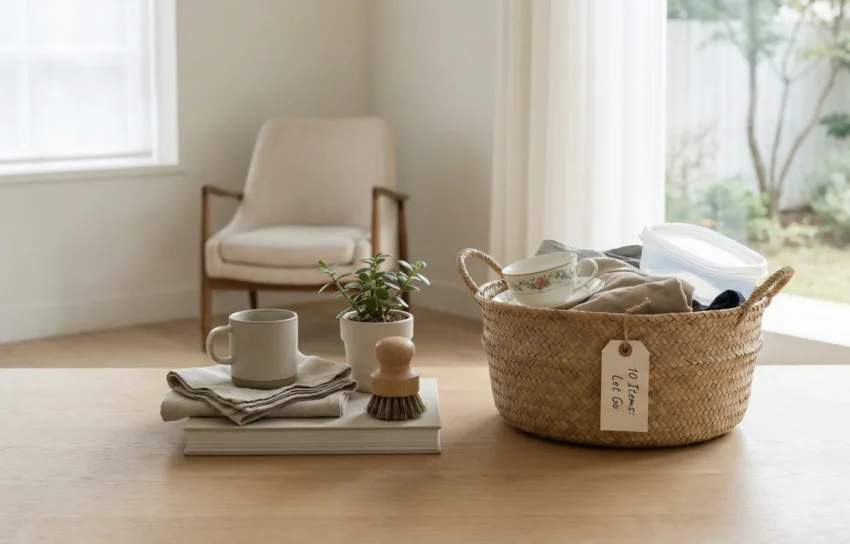
The 10-10 decluttering method (often called the 10-10-100 rule) is a 10-day challenge where you commit to removing 10 unnecessary items from your home every day. By focusing on small, manageable “bite-sized habits” rather than a total overhaul, you successfully remove 100 items in under two weeks without experiencing decision fatigue or emotional burnout.
According to research published in The Journal of Environmental Psychology, physical clutter in one’s living environment can significantly increase cortisol levels, leading to chronic stress and decreased focus.
You know that feeling when you walk into a room and your shoulders immediately tighten? It’s not just the pile of mail on the counter or the three half-empty coffee mugs. It’s the visual noise. Your home should be a sanctuary, but lately, it feels like a physical manifestation of your “to-do” list.
When people ask, “How do I start decluttering when I’m overwhelmed?” they aren’t looking for a weekend-long marathon. They are looking for air. This is where the 10-10 decluttering method comes in. Many wonder, “What is the 10-10-100 decluttering rule?” and the answer is refreshingly simple: you find 10 things to let go of, every day, for 10 days.
People often doubt the math: “Can you really declutter 100 items in 10 days?” The answer is a resounding yes, because most of us are carrying around hundreds of items we don’t even see anymore. By turning this into a decluttering challenge, we stop treating “cleaning up” as a grand event and start seeing it as a series of bite-sized habits.
If you’re wondering, “What are some easy zones to declutter first?” think of the places where junk naturally pools—the junk drawer, the medicine cabinet, or the digital graveyard of your phone. Using this simple organizing strategy, you can tidy up in minutes without the emotional hangover of a “Swedish Death Cleaning” session. Let’s look at how these viral decluttering hacks can actually lead to a slower, more intentional life.
Check the Decluttering category for more posts.
Why does clutter hurt? The biological cost of too much “stuff”
We often think of clutter as a moral failing or a sign of laziness. It’s neither. It is actually a tax on your brain’s processing power.
Your brain is constantly scanning your environment. Every object in your field of vision represents a “task” or a “memory” your brain has to process. When your space is filled with things you don’t love or use, your brain stays in a state of low-level “alert.”
This constant scanning affects your neuroplasticity—which is just a fancy way of saying your brain’s ability to rewire its own habits. When you are surrounded by chaos, your brain finds it harder to settle into the calm, creative states required for slow living.
A study from Princeton University found that physical clutter competes for your attention, much like a crying toddler might. It limits your ability to focus and decreases your productivity. By using the 10-10 decluttering method, you aren’t just cleaning a shelf; you are lowering your baseline stress levels.
Is there a simpler way to use the 10-10-100 method?
Most people fail at decluttering because they try to do too much at once. They pull everything out of the closet, get tired two hours later, and end up sleeping on the sofa because the bed is covered in clothes.
| Marathon Cleaning | 10-10 Method |
| Emptying entire rooms at once. | Focusing on 10 specific items. |
| All-day sessions that lead to burnout | 15-minute daily “sweeps.” |
| High emotional “decision fatigue.” | Low-stakes, quick decisions |
| Creates a bigger mess before it gets better | No visible mess created during the process |
| Often abandoned halfway through | High completion rate due to low friction |
The beauty of the 10-10-100 method is that it respects your time and your energy. It acknowledges that you have a life, a job, and perhaps a family that needs you. It doesn’t demand a weekend; it only asks for a few minutes of intentionality.
How do I start the 10-10-100 decluttering challenge today?
Starting is the hardest part of any journey. To make this work, you need to lower the barrier to entry until it’s almost impossible to say no.
-
The Ten-Minute Timer: Set a timer on your phone. This isn’t a race, but a boundary. When the timer goes off, you stop, regardless of whether you’ve found 10 items or not (though you usually will).
-
The “Low-Hanging Fruit” Ritual: Pick one zone per day. Don’t wander through the whole house. If it’s the bathroom day, stay in the bathroom.
-
The Immediate Exit: Have a box or bag ready. The moment an item is designated “out,” it goes into the bag. Once you hit 10, the bag goes to the car or the bin. Do not let the “discard” pile sit in the house and wait for a second look.
The 10-Day Road Map (Including the Digital Detox)
To reach that goal of 100 items, you need a plan. Here is how to break down your 10-10 decluttering method across the different “zones” of your life.
Day 1: The Kitchen Junk Drawer
We all have one. The dead batteries, the soy sauce packets from 2022, and the mysterious keys that don’t fit any lock you own. Finding 10 items here takes about three minutes.
Day 2: The Bathroom Cabinet
Expired ibuprofen, sunscreens that have lost their SPF, and travel-sized shampoos you’ll never use. Check the dates; if it’s expired, it’s gone.
Day 3: The “Digital Zone” (Digital Detox)
This is where the 10-10-100 method becomes modern. Our phones are the new attics.
-
Delete 10 apps you haven’t opened in a month.
-
Unsubscribe from 10 marketing emails.
-
Delete 10 blurry photos or screenshots you no longer need.
-
[Link to: Why Digital Minimalism is the New Essential]
Day 4: The Entryway/Mudroom
Old shoes that hurt your feet, umbrellas that are snapped, or reusable bags that have holes. Clear the path you walk through every time you come home.
Day 5: The Linen Closet
Towels that have turned into sandpaper and bedsheets for a mattress size you no longer own. Keep the best, donate the rest.
Day 6: The Bookshelf
This one is hard for some, but be honest. Are there 10 books you know you will never read again? Let someone else discover them.
Day 7: The Wardrobe (Accessories)
Don’t touch the clothes yet. Look at the socks with holes, the stretched-out hair ties, and the scarves you haven’t worn in three winters.
Day 8: The Fridge and Pantry
Check the back of the shelf. That jar of specialty mustard you bought for one recipe? If it’s crusty, toss it.
Day 9: The Office/Paperwork
Manuals for electronics you’ve already recycled, old receipts, and pens that are out of ink.
Day 10: The Wardrobe (The Big One)
By now, you have momentum. Find 10 pieces of clothing that don’t fit your body or your current lifestyle.
The Counter-Intuitive Truth: Why “Fast” Isn’t the Goal
In the world of viral decluttering hacks, the focus is usually on how quickly you can make a room look “Pinterest-perfect.” But in the philosophy of slow living, we look at it differently.
The goal of the 10-10 decluttering method isn’t actually to get rid of 100 things. The goal is to train your “discard muscle.” We have been conditioned by a consumerist culture to acquire, keep, and store. We are experts at “bringing in,” but we are novices at “letting go.”
By doing this for 10 days, you are practicing the art of detachment. You are proving to yourself that you can live with less and that the world doesn’t end if you don’t have three spare whisks. The “100 items” is just the metric; the real prize is the mental space you reclaim.
The Decision Tree: Should It Stay or Should It Go?
If you find yourself stuck on an item, use this simple logic flow.
-
Have I used this in the last year?
-
Yes: Move to question 2.
-
No: Let it go.
-
-
Does it serve a vital function or bring me genuine joy?
-
Yes: Keep it.
-
No: Let it go.
-
-
If it disappeared tomorrow, would I go out and buy it again?
-
Yes: Keep it.
-
No: Let it go.
-
Sustainability: Where do those 100 items actually go?
A major “gap” in most decluttering advice is the “away.” We say we’re “throwing things away,” but there is no such place as “away.” To keep this process high-end and intentional, we must be responsible for the exit.
-
Textiles: Don’t throw old clothes in the trash. Look for textile recycling programs like Terracycle or local animal shelters that need old towels.
-
Eyeglasses: Organizations like Lions Club International collect used prescription glasses for those in need.
-
Electronics: Never put batteries or old phones in the bin. Use Best Buy’s recycling program or your local e-waste center.
-
Makeup: If it’s expired, it’s trash, but some brands like MAC or Origins have “Back-to-MAC” style programs for recycling the packaging.
Frequently Asked Questions
Is the 10-10-100 method sustainable for long-term minimalism?
Yes. Unlike a one-time “purge,” this method builds a habit. Many people find that after the 10 days are up, they naturally continue to look for things to let go of as part of their daily rhythm.
How does the 10-10-100 method compare to the KonMari method?
The KonMari method is a “category-based” deep dive that requires significant time and emotional energy. The 10-10 method is a “zone-based” approach designed for people who need a low-friction way to start without the intensity of a full-house overhaul.
What if I have more than 10 items in a zone?
That’s great! But for the purpose of the challenge, stop at 10. The goal is to prevent burnout. If you do 50 items today, you might be too exhausted to do 10 tomorrow. Consistency beats intensity every time.
Can I include digital items in my 100 count?
Absolutely. Modern clutter is often invisible. Clearing 10 unread emails or 10 old desktop files provides the same “dopamine hit” of accomplishment and reduces mental drag just as much as a clean counter.
The One-Minute Challenge
Right now, don’t worry about the next 10 days. Just look around the room you are currently in. Find three things that are trash, broken, or serve no purpose. Put them in the bin or a donation bag immediately.
You’ve just started. How does that feel?
